
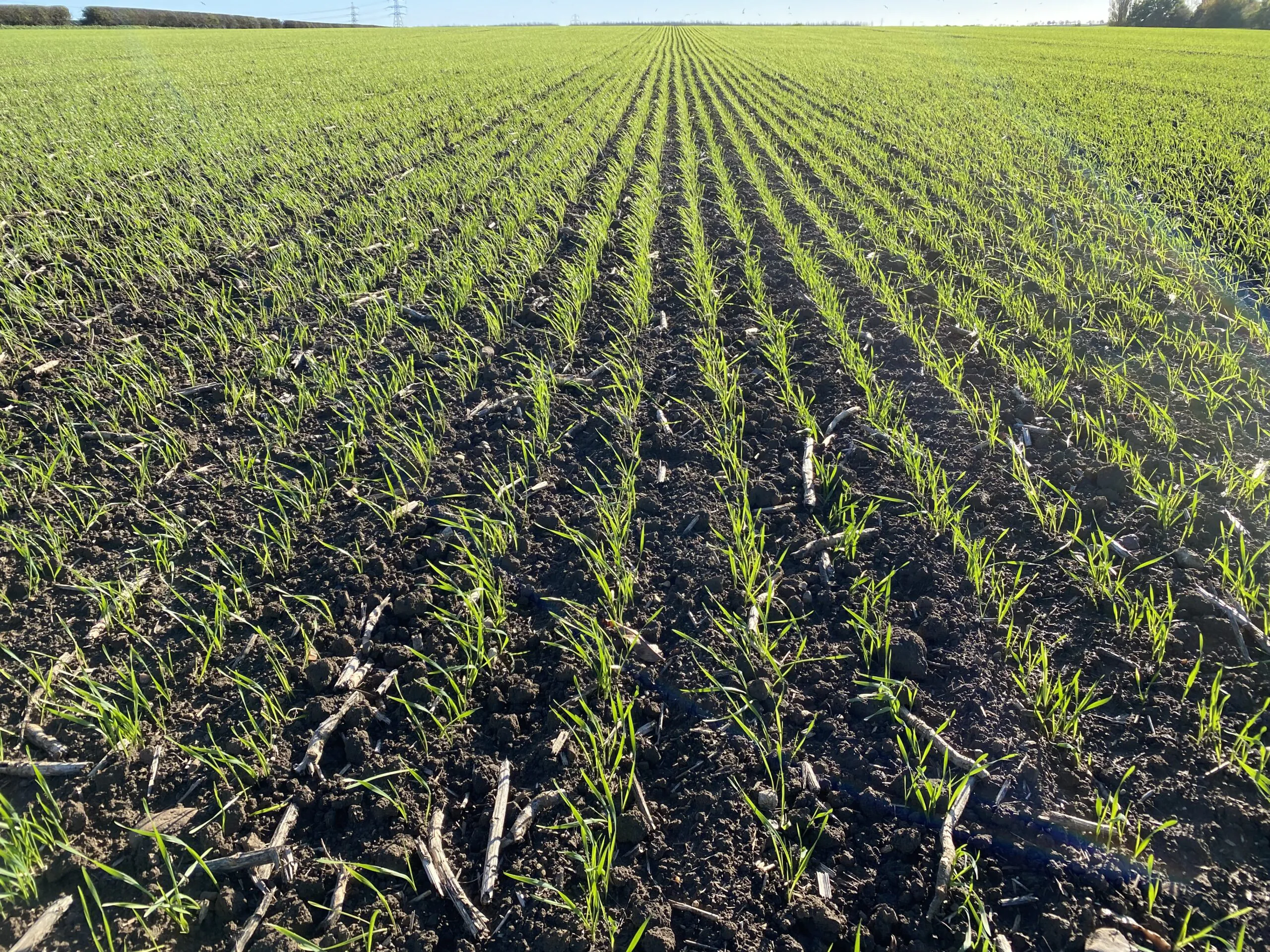

Setting the Foundations for Harvest 2027
Cereal crop establishment is now underway, with drills flying as growers sow the seeds ready for harvest 2027. Getting crops off to the best possible start is essential to optimising yield and profitability.
The old saying “well sown, half grown” still rings true. Regardless of whether you are using the latest shiny drill, or a 40-year-old Massey 30, a good seedbed is critical. This is particularly important when it comes to optimising weed control through residual herbicides, along with managing the slug risk, which prefer a loose cloddy seedbed. A consolidated seedbed will help prevent manganese deficiency.

Building Yield from the Ground Up
If we look at the fundamentals of cereal crop yield it is driven by three main pillars, Correct crop nutrition plays an important role in each of these:
- The number of ears per square metre
- The numbers of grains per ear
- The size of the grain
The AHDB benchmark numbers for an 11 ton per hectare wheat crop are:
- 460 ears per square metre
- 48 grains per ear
- 50 mg weight per grain
Barley is slightly different, with the number of ears per square metre having a greater impact. Hence, with the exception of hybrid barley, seed rates are generally higher. For reference, an 8.8 ton per hectare barley crops requires:
- 775 ears per square metre
- 25 grains per ear
- 46 mg weight per grain

Building the Foundations for Yield
I always point out that if you get the basics wrong at the start, you are already playing catch up. In this case the seed rate is critical. Work this out using the thousand grain weight of your seed. There are large variances between varieties and batches, so don’t just assume 200 kg/ha will be right. It will likely be wrong on all accounts.
The first phase of crop development is termed “the foundation phase”. In this stage the focus is developing both above and below grown biomass. The below ground element (roots) is extremely important and often overlooked.
The ADAS YEN project highlighted that crops with a higher biomass in spring generally went on to yield more than those without. This should not come as any surprise given the first pillar of yield in number of ears per square metre. However, like any large structure (e.g. a large bridge or a high rise building) the crop needs a strong foundation to support that biomass = the root system.
Strong Roots, Stronger Crops
It is well documented that plants with a large root system have enhanced crop growth and yield. This is particularly important during periods of drought where both water and nutrient (particularly nitrogen) availability can be limited. The larger the root system, the more soil it can savage for these essential components of yield.

Making Phosphate Available When Crops Need It
Phosphate is a critical nutrient for early root and shoot development. However, as we have discussed previously the availability from the soil is limited by a number of factors including soil pH, where phosphate is locked up by aluminium/iron at low pH and calcium at high pH. The second factor is soil temperature, as soils cool, phosphate availability reduces. A final consideration is the fact phosphate does not move far within the soil profile. Therefore, early in crop development it doesn’t have the root system to find that phosphate.
This is where phosphites can help. Phosphites have been proven through many scientific studies to increase rooting. This has also been backed up by many years of field usage. Phosphites are rapidly absorbed by the leaf (bypassing those negative soil interactions) and tricking the plant into thinking it is short of phosphate. This in turn stimulates lateral root production. As above, this bigger root system supports the crops biomass in the spring, delivering higher yields and increased profitability.

Kickstarting Root Growth This Autumn
Kickstart from OMEX has been proven through independent scientific studies at The University of Nottingham to deliver enhanced root growth over competitor products. Kickstart also includes nitrogen to aid uptake and potassium which can improve frost tolerance. Used at 1.0 l/ha at growth stage BBCH 14 it is an extremely cost effective solution, leading to improved root and shoot growth.
Kickstart
Understanding Manganese Deficiency
At this autumn timing, it worth remembering manganese, as this deficiency is the most widespread of all nutrients yet so simple to mitigate against. Manganese plays a number of important roles within the plant. These include improving photosynthesis by having a healthy canopy, activating a number of enzymes to improve energy transfer within the plant, and can also have an impact on take all. Risk factors are light sandy soils, calcareous soils, soils high in organic matter and as mentioned at the start, fluffy unsolidated seedbeds.

Your Manganese Deficiency Solution
OMEX SuperMn is a combination of both nitrate and sulphate sources creating a highly efficient manganese solution. SuperMn also contains magnesium to aid uptake and improve winter hardiness. By utilising both manganese sulphate and manganese nitrate, SuperMn gives a rapid correction of deficiency along with sustained crop feeding. This has been proven to outperform standard sulphate products for a similar cost per ha.
supermn
Set Crops Up for Harvest 2027
Both Kickstart and SuperMn are physically tank mixable with key autumn crop protection products.
Do not miss this opportunity to enhance establishment, ensuring crops are set up for harvest 2027.
get in touch